
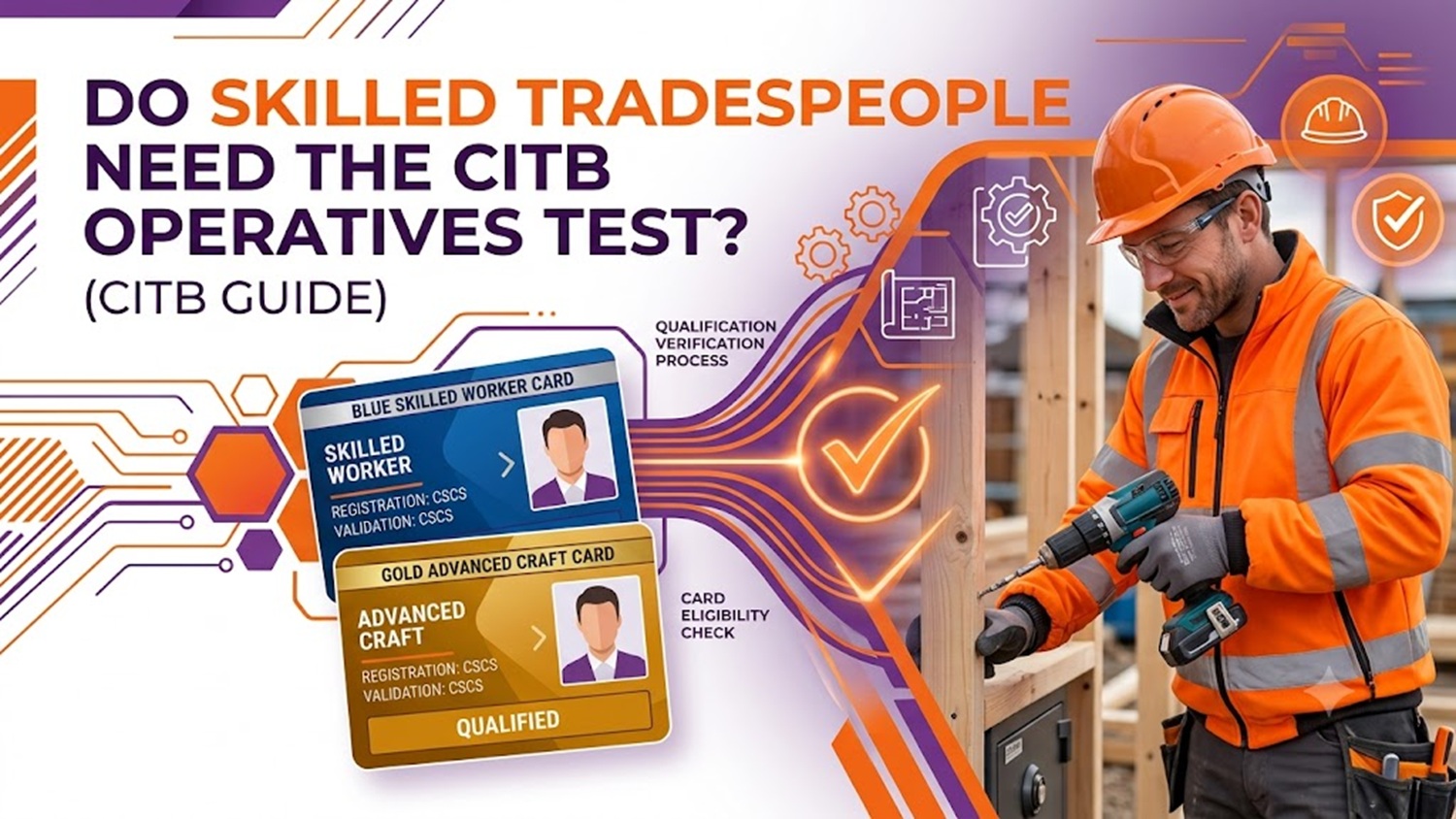
If you are a qualified carpenter, electrician, plumber, or bricklayer, looking at a test labeled “CITB Health, Safety and Environment Test for Operatives“ can be confusing—or even feel like a step down.
You’ve spent years honing your craft, earning your NVQs, and building a career as a skilled tradesperson. You aren’t a general site labourer, so why are training providers and site managers telling you to book an “Operative” test to get your Blue or Gold CSCS card?
In this guide, we’ll clear up the terminology, explain why skilled tradespeople take the Operatives test, cover all specialist test categories, and show you exactly what accessibility support (like voiceovers) is available.
Why Is It Called an “Operative” Test If You Are a Skilled Tradesperson?
The confusion comes down to industry jargon.
In everyday site language, people often distinguish between “labourers” (unskilled or entry-level workers) and “tradespeople” (qualified craftsmen). However, the Construction Industry Training Board (CITB) uses the word “Operative” as an overall administrative category.
To the CITB, an “Operative” is simply anyone carrying out hands-on, ground-level operational work on a construction site, as opposed to someone in a supervisory or management role.
A Universal Safety Baseline
Whether you are laying bricks, installing complex electrical wiring, or carrying out general clearance, the fundamental hazards of a construction site are the same. The Operative Health, Safety & Environment (HS&E) test is designed to ensure that every single person on site shares a mandatory safety baseline:
-
Hazard Awareness: Identifying site hazards, safety signs, and dangerous environment conditions.
-
Emergency Procedures: First aid response, fire prevention, and emergency evacuation protocols.
-
Health & Welfare: Dust control, noise hazards, hazardous substances (COSHH), and manual handling safety.
-
High-Risk Activities: Basic safety rules around working at height, electricity, and heavy plant equipment.
Your trade qualification (such as an NVQ Level 2 or 3) proves to employers that you know how to do your trade. Passing the CITB Operatives test proves that you know how to stay safe on a live site while doing it.
Which CSCS Card Requires the CITB Operatives Test?
To get a Construction Skills Certification Scheme (CSCS) card, you generally need two things: proof of qualification (your NVQ or equivalent) and a valid CITB HS&E test pass achieved within the last two years.
Here is how the Operative test aligns with standard CSCS card types:
| CSCS Card | Qualifications Needed | Required CITB HS&E Test |
| Green Card (Labourer) | Level 1 Award in Health & Safety in a Construction Environment | Operatives Test |
| Blue Card (Skilled Worker) | NVQ/SVQ Level 2 in a recognized construction trade | Operatives Test (or Specialist) |
| Gold Card (Advanced Craft) | NVQ/SVQ Level 3 in a recognized construction trade | Operatives Test (or Specialist) |
| Gold Card (Site Supervisor) | NVQ/SVQ Level 3 or 4 in Site Supervision | Supervisors Test |
| Black Card (Senior Manager) | NVQ/SVQ Level 6 or 7 in Site Management | Managers & Professionals (MAP) Test |
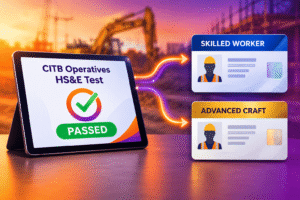
As shown above, the CITB Operatives test is the standard safety requirement for the Blue Skilled Worker and Gold Advanced Craft cards.
Complete List of CITB Specialist Tests (When Operatives Isn’t Enough)
While the general Operative test covers most standard trades, certain sectors require candidates to take a dedicated Specialist HS&E Test.
If your specific trade falls into one of the following categories, you must book the corresponding Specialist exam instead of the standard Operative test:
-
Supervisory (SUP)
-
Demolition (DEM)
-
Plumbing (JIB) (PLUM)
-
Highway Works (HIW)
-
Specialist Work at Height (WAH)
-
Lifts and Escalators (LAEE)
-
Tunnelling (TUNN)
-
HVACR – Heating and Plumbing Services (HAPS)
-
HVACR – Pipefitting and Welding (PFW)
-
HVACR – Ductwork (DUCT)
-
HVACR – Refrigeration and Air Conditioning (RAAC)
-
HVACR – Services and Facilities Maintenance (SAF)
Tip: Always check the requirements for your specific affiliated card scheme (such as JIB-PMES for plumbers or ECS/JIB for electricians) before booking to make sure you select the correct module.
Voiceover Options and Language Support
If English isn’t your first language, or if you struggle with reading long technical texts, CITB provides voiceover assistance.
When taking the Operatives Test, headphones are provided, and you can request an audio voiceover in any of the following 14 languages:
-
English
-
Welsh
-
Bulgarian
-
Czech
-
French
-
German
-
Hungarian
-
Lithuanian
-
Polish
-
Portuguese
-
Punjabi
-
Romanian
-
Russian
-
Spanish
Important Note: For Specialist and Managers & Professionals tests, voiceovers are generally restricted to English and Welsh. Additionally, while the audio questions are translated into your selected voiceover language, the text on screen will remain in English. Make sure to select your preferred voiceover language at the time of booking, as it cannot be changed on test day.
CITB Operative Test: Key Facts at a Glance
-
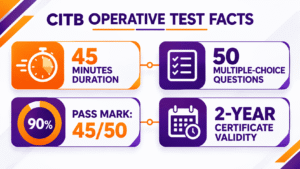
Total Questions: 50 multiple-choice questions
-
Time Allowed: 45 minutes
-
Pass Mark: 45 out of 50 (90%)
-
Format: Computer-based test at an approved test center
-
Validity: 2 years from the date of passing
Frequently Asked Questions (FAQs)
Is the CITB Labourer test different from the Operative test?
No. They are the exact same test. The official title is the CITB Health, Safety and Environment Test for Operatives. General labourers take it to get their Green Card, while qualified tradespeople take it alongside their NVQ Level 2/3 to get their Blue or Gold Card.
Does taking the Operative test mean my card will say “Labourer”?
No. Your CSCS card color and title are determined by your NVQ trade qualification, not the test name. If you have an NVQ Level 2 in Carpentry and pass the CITB Operative test, you will receive a Blue Skilled Worker Card listing your trade as Carpenter.
Can I request a voiceover on the day of my test?
No. You must select your required voiceover language when booking the test in advance so the system can set up your exam profile correctly.
Do I need to re-take the CITB Operative test every time I renew my CSCS card?
Yes. CSCS cards are valid for 5 years, while CITB HS&E test pass certificates are valid for 2 years. You must pass a CITB test within the 2 years prior to submitting your CSCS card renewal application.
What happens if I fail the CITB Operative test?
If you do not meet the 43/50 pass mark, you can rebook the exam. However, CITB policy requires a mandatory 48-hour waiting period before you can retake the test at an approved center.
Can I take the CITB Operative test online from home?
CITB offers a home-testing option called CITB HS&E Test at Home, provided you meet strict technical requirements (such as a dual-camera setup, stable internet, and a quiet room). Alternatively, you can take it in person at a local CITB-approved test center.
Does an NVQ qualification replace the need for a CITB Operative test?
No. Your NVQ and your CITB test serve two different purposes. The NVQ proves your occupational skill and trade competence, while the CITB test verifies your immediate health and safety awareness on live sites. You must have both to receive your Blue or Gold CSCS card.
What ID do I need to bring to the CITB Operative test center?
You must bring one form of primary photo ID that features your full name, signature, and photograph—such as a valid UK Driving Licence or Passport. If you do not have primary photo ID, you must complete a CITB Waiver Form with an acceptable secondary ID prior to your test date.
What is the difference between a CSCS card and a CITB test?
The CITB test is the health and safety exam you take to prove safety competence. The CSCS card is the physical/digital ID card issued by the Construction Skills Certification Scheme once you submit proof of your trade qualifications and your valid CITB test pass.
Ready to Get Carded and On-Site?
Taking the CITB Operatives Test is simply a necessary step to prove your health and safety awareness, allowing you to access commercial construction sites across the UK.
Don’t let test confusion hold back your career. Book your CITB Health, Safety & Environment Test today and take the next step toward securing your Blue or Gold CSCS card!