
Navigating the UK construction sector as an internationally trained professional comes with immediate, rewarding opportunities. The UK market consistently demands skilled tradespeople, site supervisors, and engineers. However, stepping onto an active UK construction site requires meeting strict compliance standards, chief among them possessing a CSCS card (Construction Skills Certification Scheme).
If you obtained your construction, engineering, or trade qualifications outside the UK, you might wonder: Does my foreign degree or trade certificate count? Do I have to start my training from scratch?
The short answer is no, you do not have to restart your training. However, you cannot simply present an overseas certificate at a UK site gate. There is a precise, regulated pathway to translate your international credentials into an officially recognized CSCS card.
This guide provides a step-by-step breakdown of converting foreign qualifications into a valid UK CSCS card, the role of Ecctis, required CITB tests, and how to fast-track your UK site entry.
What is a CSCS Card and Why Do You Need One?
The Construction Skills Certification Scheme (CSCS) is the leading skills certification scheme within the UK construction industry. A CSCS card provides on-site proof that individuals working on construction sites have the required training, qualifications, and health and safety knowledge for the type of work they carry out.
While holding a CSCS card is not a strict legal requirement under UK statute, over 80% of UK construction sites and main contractors enforce a mandatory CSCS policy. Without the correct card:
- Main contractors will deny you site access.
- Recruitment agencies cannot place you into trade or management roles.
- Your professional indemnity and site safety compliance remain unverified.
Each card color signifies a specific level of skill, responsibility, and qualification—ranging from Green (Labourer) and Blue (Skilled Worker) to Gold (Advanced Craft/Supervisor) and Black (Manager).
Can You Use Overseas Qualifications Directly for a CSCS Card?
The CSCS does not directly evaluate foreign certificates, diplomas, or degrees. If you present a civil engineering degree from India, a carpentry diploma from South Africa, or an electrical certification from the Philippines, the CSCS team cannot validate its UK equivalent on their own.
To bridge this gap, CSCS collaborates with Ecctis (formerly UK NARIC), the national agency responsible for providing official recognition and comparison of international qualifications.
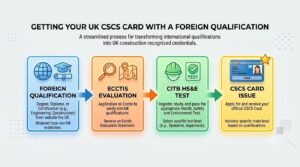
To get a CSCS card using overseas qualifications, you must go through a three-step validation framework:
- Academic/Vocational Mapping: Obtain a Industry Skills Statement or Qualification Comparison Statement from Ecctis as well as Primary Source Verification (PSV) report.
- Original Certificate copy: Need to produce copy of original certificate.
- Health & Safety Verification: Pass the appropriate CITB Health, Safety and Environment Test.
- Card Application: Submit your verified documents directly to CSCS or through an accredited training provider.
Step-by-Step Guide: Converting Foreign Credentials into a CSCS Card
Step 1: Obtain an Ecctis Evaluation Statement
Before applying for your CSCS card, your overseas qualifications must be mapped against the UK National Qualifications Framework (NQF) or Regulated Qualifications Framework (RQF).
You must apply online via the official Ecctis portal for a CSCS Industry Skills Statement.
Documents You Need to Submit to Ecctis:
- A clear copy of your original qualification certificate(s).
- Full academic transcripts or mark sheets.
- A certified English translation (if your documents are not originally in English).
- Official proof of your passport or national ID.
- Evidence of your professional experience (letters from previous employers detailing your role, tasks, and years active).
Important Note: Ecctis evaluates formal vocational and academic qualifications. If your foreign training was informal or uncertified, you may need to complete a UK-based Recognition of Prior Learning (RPL) or NVQ assessment through a provider like B2BNC Training.
Step 2: Book and Pass the Relevant CITB HS&E Test
Regardless of your foreign qualifications or years of experience abroad, everyone working on a UK construction site must demonstrate up-to-date knowledge of UK health and safety legislation.
You must pass the Construction Industry Training Board (CITB) Health, Safety and Environment Test within two years of applying for your card. The specific test you take depends on the card level you require:
- Operatives Test: Required for the Green Labourer Card and basic trade entry.
- Specialists Test: Required for specific skilled trades (e.g., plumbing, scaffolding, HVAC).
- Managers and Professionals (MAP) Test: Required for Gold (Supervisor) and Black (Manager) cards.
Step 3: Apply for Your CSCS Card
Once you receive your official Ecctis Industry Skills Statement and Primary Source Verification (PSV) report confirming UK equivalency and your CITB HS&E pass certificate, you can lodge your application with CSCS.
You will upload:
- Your Ecctis mapping document.
- Your CITB HS&E test ID.
- Proof of identity.
- Payment for the CSCS application fee.
Mapping Overseas Roles to CSCS Card Colors

To ensure you apply for the correct card, review how common international qualifications align with UK CSCS card tiers:
| Overseas Qualification Level | Equivalent UK Standard | Appropriate CSCS Card Color |
| Basic site experience / Unskilled labor | Level 1 Award in Health & Safety in a Construction Environment | Green (Labourer) |
| Completed Vocational Trade Apprenticeship / Technical Certificate | NVQ Level 2 or 3 | Blue (Skilled Worker) or Gold (Advanced Craft) |
| Foreign Site Supervisor Diploma / Trade Leadership Certificate | NVQ Level 3 or 4 | Gold (Supervisor) |
| Civil Engineering Degree / Construction Management Degree | NVQ Level 6 or 7 / Bachelor’s / Master’s Degree | Black (Manager) or PQP (Professionally Qualified Person) |
Overcoming Common Hurdles for Overseas Workers
Moving into the UK construction sector presents unique challenges. Understanding these common obstacles helps prevent delays in gaining site access:
1. Document Translation Issues
If your qualification documents are translated informally, Ecctis will reject them. Always use a sworn translator or an accredited translation agency recognized in the UK.
2. Lack of Practical Assessment Proof
Some overseas degrees are purely theoretical and lack documented practical site training. In such cases, Ecctis may map your academic knowledge but note a gap in practical NVQ equivalency. Completing a short-track NVQ assessment in the UK fills this gap without requiring you to retake fundamental courses.
3. Language Barriers in Safety Exams
The CITB HS&E test is conducted in English, though voiceover translations are available in several major languages (e.g., Polish, Romanian, Russian, Punjabi, Hungarian), but that is only for Operative Test only. If your English comprehension is developing, practicing with official revision materials or completing tutor-led prep courses dramatically increases your pass rate.
Why Choose B2BNC Training for Your UK Construction Journey?
Navigating foreign qualification mapping, CITB exam bookings, and NVQ equivalencies can be complex. Working with an experienced, UK-accredited training partner eliminates guesswork and speeds up your path to working on site.
- Comprehensive CSCS Support: From identifying your card tier to booking your CITB test, B2BNC Training guides you through every step.
- Accredited Health & Safety Courses: Access mandatory safety awareness courses necessary for card applications.
- NVQ Assessment & Fast-Tracking: If your overseas qualification falls short of full UK NVQ equivalency, our assessors help you achieve UK-recognized NVQs through On-Site Assessment and Training (OSAT), turning your existing skills into certified UK qualifications.
- Corporate & Individual Booking Options: We work directly with site managers and agencies to get entire teams trained, compliant, and carded efficiently.
Whether you need to secure your initial Green Labourer Card or convert an international engineering degree into a Black Management Card, B2BNC Training offers the accredited courses, guidance, and testing support required to get you site-ready.
Frequently Asked Questions (FAQs)
1. How long does it take to convert overseas qualifications for a CSCS card?
The timeline depends heavily on document processing. Ecctis evaluations typically take 10 to 15 working days (express services are available), however you need to check and apply directly with UK ECCTIS. Once you pass your CITB test and submit your verified documents to CSCS, card issuance usually takes an additional 3 to 7 working days.
2. How much does it cost to get a CSCS card with foreign credentials?
Costs generally break down as follows:
- Ecctis Industry Skills Statement: Approximately £140 – £210 + VAT (depending on processing speed).
- CITB HS&E Test: £22.50 (standard test fee).
- CSCS Card Application Fee: £36.
- Optional preparatory training or NVQ assessment fees through providers like B2BNC Training.
3. Can I work on a UK construction site while waiting for my Ecctis result?
Technically, no main contractor will allow you onto a site without a valid card or a temporary pass. However, if you need immediate site access, you can apply for a Temporary CSCS Card (such as a Red Provisional Card) if you are currently enrolled in a recognized UK qualification or NVQ course.
4. What if Ecctis states my foreign qualification is not equivalent to a UK standard?
If Ecctis cannot match your qualification to a UK benchmark, you do not lose your industry knowledge. You can undertake an Experienced Worker Practical Assessment (RPL) via a recognized UK provider. This path evaluates your existing trade skills on-site without forcing you to complete a multi-year course.
5. Do I need a CSCS card if I am a self-employed subcontractor?
Yes. Self-employed status does not exempt you from site safety rules. Principal contractors require all individuals on site—whether direct employees or sub-contractors—to carry a valid CSCS card corresponding to their role.
6. Do I need an English language test to get a CSCS card?
CSCS itself does not require a formal English language certificate (like IELTS). However, you must be able to understand health and safety briefings on site and pass the CITB Health, Safety and Environment test.