
If you are planning to complete an NVQ course, one of the first questions you will probably ask is: “What evidence do I actually need?” This is one of the most common concerns for learners across the UK, especially in construction and trade – related qualifications.
The good news is that an NVQ is not about sitting traditional exams. Instead, it is based on proving that you can carry out your job to the required industry standard. Most of the evidence comes from the work you already do every day, which means experienced workers often have more evidence than they realise.
In this guide, we will explain what counts as NVQ evidence, how much you need, and what to do if you think you do not have enough.
What Is NVQ Evidence?
NVQ evidence is any proof that demonstrates you are competent in your role. Your assessor uses this evidence to confirm that you can perform the tasks required by the qualification.
Rather than testing you in a classroom, the NVQ assessment process looks at your real work. This makes NVQs particularly suitable for people who are already employed and want to gain a recognised qualification without leaving their job.
The exact evidence required will depend on the NVQ level and the job role, but the overall aim is the same: to show that you consistently work safely, correctly, and to industry standards.
Types of Evidence for an NVQ
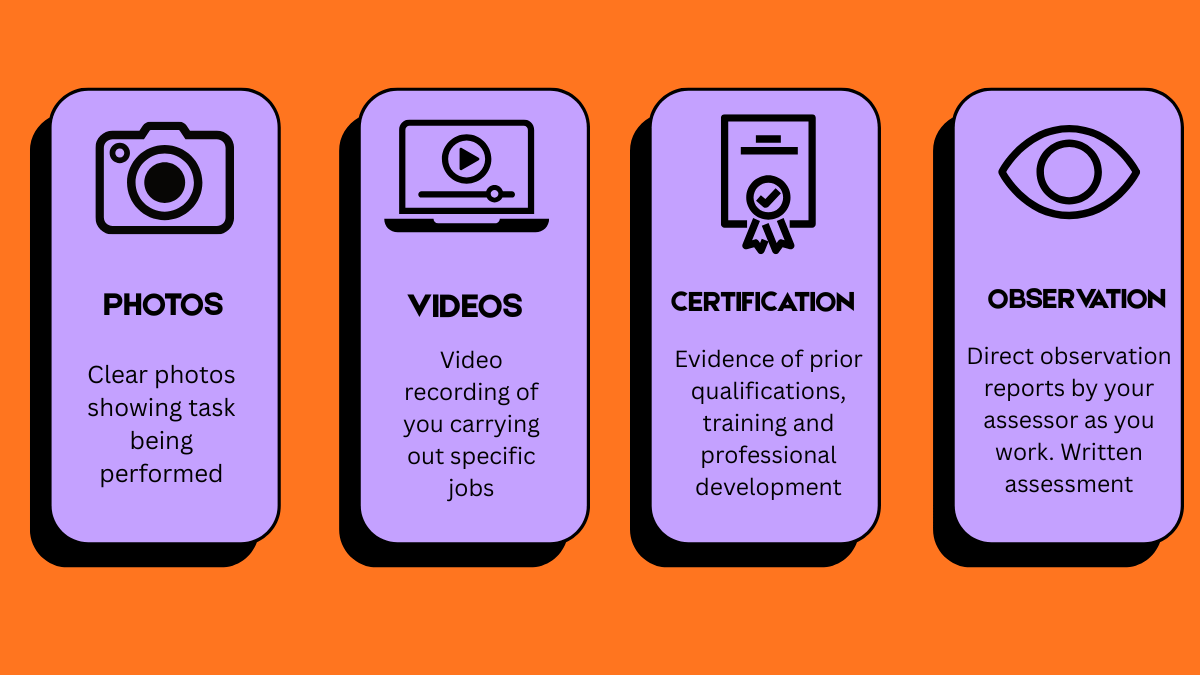
Most NVQ portfolios contain a combination of different evidence types. Here are the most common examples.
Assessor Observation
An assessor may observe you carrying out tasks in the workplace. This is often considered one of the strongest forms of evidence because it shows your skills in a real working environment.
Photos of Your Work
Clear photographs of completed work can be used to support your portfolio. For example, a construction worker might provide photos of brickwork, plastering, roofing, or other completed tasks.
Videos
Short videos can also be useful, particularly for demonstrating practical activities that are difficult to capture in a single photo.
Witness Testimonies
A supervisor, manager, or experienced colleague may provide a witness statement confirming that they have seen you carry out certain tasks competently.
Professional Discussions
Your assessor may hold a structured discussion with you about your work, responsibilities, and
decision-making. This can help provide evidence for knowledge-based units.
Workplace Documents
Job sheets, risk assessments, method statements, drawings, inspection records, and other workplace documents may be included where appropriate.
Certificates and Training Records
Relevant training certificates, such as health and safety qualifications, may support your portfolio, although they are usually supplementary evidence rather than the main evidence.
What Does a Good NVQ Portfolio Look Like?
A strong portfolio does not simply contain lots of documents. It contains evidence that clearly matches the requirements of the qualification.
For example, if an NVQ unit requires you to demonstrate safe working practices, evidence might include:
• An assessor observation.
• Photos of you using the correct PPE.
• A witness testimony from your supervisor.
• A professional discussion about site safety procedures.
The best portfolios combine practical evidence with supporting documentation.
How Much Evidence Do You Need?
This is another question learners ask all the time.
There is no fixed number of photos, documents, or observations that guarantees a pass. Quality
is far more important than quantity.
Your assessor is looking for sufficient evidence to confirm that you consistently meet the standards of the qualification. In many cases, a small amount of strong evidence is better than a large amount of weak or repetitive evidence.
An experienced assessor will guide you on exactly what is needed for your specific NVQ.
Can You Use Previous Work as Evidence?
Often, yes.
If you have completed relevant work recently and can provide evidence that can be verified, it may be possible to include it in your portfolio. This can be particularly helpful for experienced workers who have already carried out many of the tasks covered by the qualification.
However, the evidence must still be relevant to the NVQ units and acceptable to the assessor.
What If You Do Not Have Enough Evidence?
Many learners worry about this before they enrol, but it is rarely a barrier.
If there are gaps in your evidence, your assessor can usually help you plan how to gather additional evidence during your normal working day.
This might involve:
• A workplace observation.
• Taking additional photos.
• Completing a professional discussion.
• Obtaining witness testimonies.
• Collecting relevant site documents.
The process is designed to work around your job rather than interrupt it.
Common Mistakes To Avoid
Collecting Random Photos
Photos should clearly show the work you completed and, where possible, demonstrate your involvement in the task.
Waiting Until the Last Minute
It is much easier to build an NVQ portfolio gradually rather than trying to gather everything at once.
Ignoring Your Assessor’s Guidance
Your assessor knows what evidence is required. Following their advice can save a lot of time.
Submitting Unclear Evidence
Blurry photos, incomplete documents, or evidence that does not clearly relate to the qualification may not be useful.
Tips for Building a Strong NVQ Portfolio
• Take clear, dated photos of your work.
• Keep copies of relevant site paperwork.
• Upload evidence regularly.
• Ask supervisors for witness statements when needed.
• Stay organised.
• Communicate with your assessor whenever you are unsure.
These simple habits can make the assessment process much smoother.
Why Good Evidence Matters
Strong evidence can make the entire NVQ process faster and less stressful. When your assessor can clearly see that you meet the required standards, there is less need for additional questioning or repeated evidence requests.
For example, a construction worker who regularly takes clear photos, keeps copies of relevant site documents, and maintains good communication with their assessor will often find that their portfolio develops smoothly. On the other hand, learners who wait until the end of the process to gather evidence may spend more time trying to locate documents or remember specific jobs.
Good evidence also helps demonstrate consistency. Assessors are not only looking for a single successful task; they want to see that you can perform your role safely and competently on an ongoing basis. This is why workplace observations, witness testimonies, and day-to-day job records can be so valuable.
The key point is that your evidence does not need to be complicated. It simply needs to show the real work you carry out and how it meets the standards of the qualification.
Frequently Asked Questions
Can photos be used as NVQ evidence?
Yes. Photos are commonly used, provided they clearly demonstrate your work and meet your assessor’s requirements.
Can I compete NVQ while working?
Yes. Most learners complete their NVQ alongside their job, which is one of the main advantages of the qualification.
How long does it take to gather evidence?
This varies depending on the qualification and your experience, but many learners can gather a
significant amount of evidence from their normal day-to-day work.
Do I need to attend College?
In many cases, no. Many NVQs are assessed in the workplace or remotely, making them suitable
for employed workers.